Rethinking a Digital Detox in a World That Never Stops Buzzing
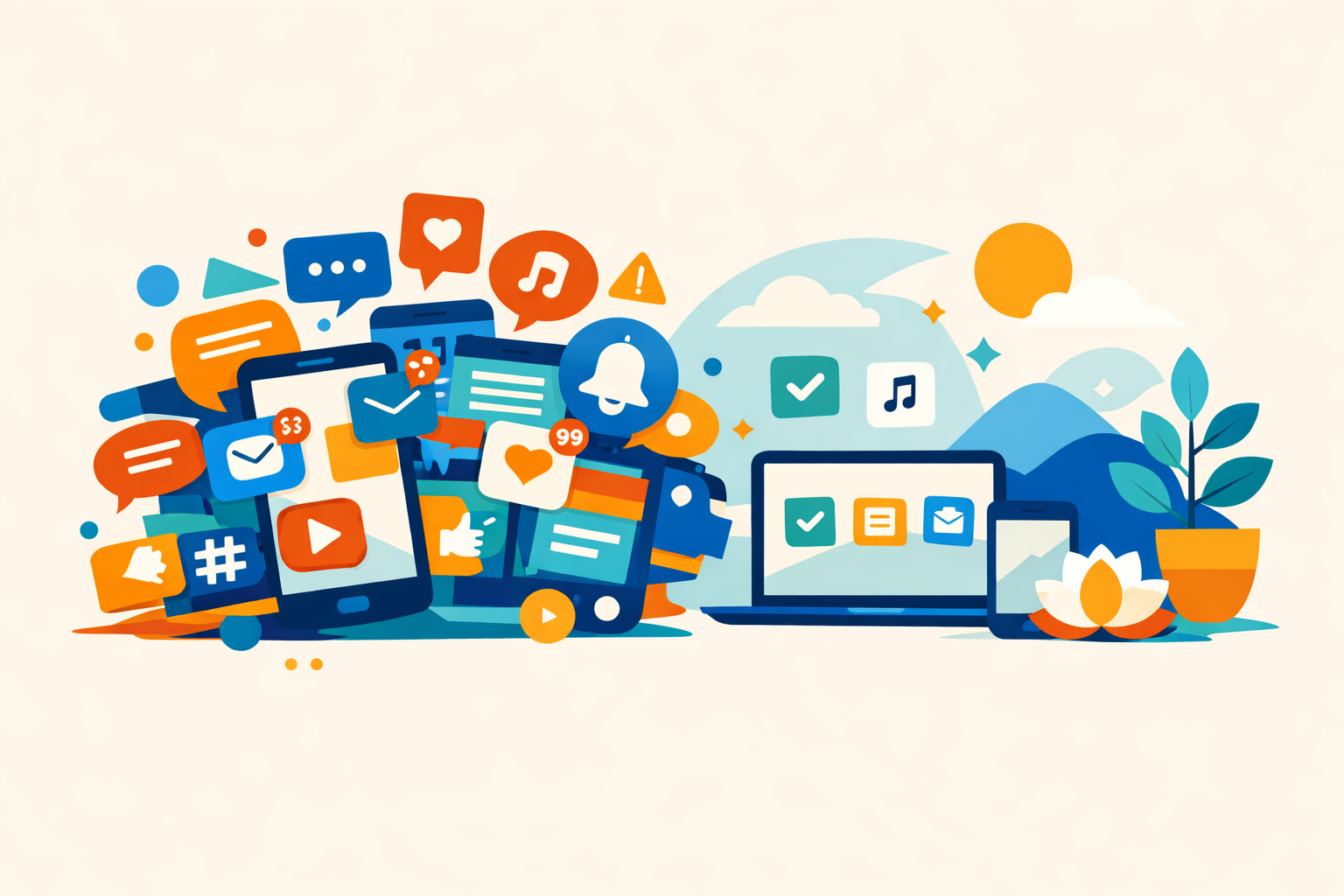
Image created with ChatGPT by the author.
Digital Clutter Goes Beyond the Physical
I read Cal Newport’s book “Digital Minimalism” a couple years back and was recently reminded of it again. I don’t consider myself a minimalist, but I do try to keep things simple. I’m always on a quest to cut some clutter out of my life and this book helped.
Newport’s book is about using technology more intentionally instead of letting it quietly run your life. He argues that many digital tools demand far more attention than they’re worth, creating constant distraction and low-grade stress. He introduces digital minimalism as a way to step back, clarify what actually matters to you, and then reintroduce technology only where it clearly supports those values.
The book recounts an experiment people volunteered for where they went through several steps of decluttering their phones of apps and then brought them back with more intention.
I’m revisiting this idea as I scroll through my phone and see so many apps I’ve downloaded, yet hardly every use and they still ping for my attention. I’ve seen the same happen on my computer, where I try all these different apps to organize my writing, creative work, etc., only to realize the redundancy and a need to simplify so I can manage it all more easily.
This quote from the book sums things up nicely:
“Digital minimalists recognize that cluttering their time and attention with too many devices, apps, and services creates an overall negative cost that can swamp the small benefits that each individual item provides in isolation.”
If you think about what this quote is saying, you can come up with a list of digital clutter minimizing the benefits of the individual apps or services.
notifications from apps
group texts
social feeds
notifications from various messaging services
And then there’s the addition of endless “just checking”. These things are always there and demanding our attention.
Digital clutter is not just what’s on our screens, but ongoing interruptions in our attention and nervous system.
∙∙∙
Why a Digital Detox Is Worth Revisiting Now
Most of us already know we are “too online.” We may even think we do a good job of managing our online time, but recognize there’s always room to take back more of that time.
Knowing and doing something about it are different.
In “Digital Minimalism”, intentionality means deciding in advance which technologies deserve your time and attention, based on your values, and then using them in clearly defined ways. It’s not about asking, “Is this useful?” but rather, “Is this the best way to support something I care about?”
Newport contrasts this with what most of us do now: adopting tools because they’re convenient, popular, or mildly beneficial, without accounting for their cumulative cost. Intentionality restores your control. You’re no longer reacting to pings and feeds. You’re choosing, on purpose, how technology fits into your life.
What is this really saying?
I don’t interpret any of this as a rejection of technology. I’ve made a career of technology and it’s always been a very big interest of mine.
When I’ve talked before about choosing what deserves your energy, the digital distractions in your life deserve consideration as part of that list. Doing so can bring:
reduced mental noise
more emotional steadiness
fewer reactive moments during the day
∙∙∙
Here’s A 7-Day Digital Reset to Try As An Experiment
Think of this as a short reset.
The goal is simple: notice what’s helping, and what isn’t.
Day 1: Notice Without Changing
Today is about awareness, not action.
Pay attention to how often you reach for your phone.
Notice what triggers it. Boredom, stress, habit, curiosity.
Just observe.
This aligns with Newport’s emphasis on seeing your current patterns before deciding what to remove.
Day 2: Reduce Interruptions
Today, quiet the background noise.
Turn off non-essential notifications.
Leave calls and messages on if you need to, but silence the rest.
Let technology wait for you instead of constantly calling for your attention.
Day 3: Create One Tech-Free Window
Choose one small pocket of your day to be phone-free.
It could be the first 30 minutes of your morning.
Meals.
The hour before bed.
You don’t need multiple boundaries. One is enough.
Notice how it feels. Easy. Awkward. Restful. Uncomfortable. All of it counts.
Day 4: Step Back From Social Media
Today is about creating a little distance.
That might mean a full day off.
Or checking once, intentionally, instead of many times by reflex.
Be curious, not disciplined.
Pay attention to what changes in your mood, attention, or stress level.
Day 5: Reclaim One Hour
Choose one hour today that normally disappears into scrolling.
Replace it with something grounding.
A walk. Reading. Cooking. Sitting outside. Writing a few lines in a journal.
Nothing productive required. Just present.
Notice what it feels like to have that hour back.
Day 6: Decide What Earns Its Place
Today is about intentional reintroduction.
Look at the apps, habits, and digital routines you’ve stepped away from and ask:
Does this support what matters to me?
Or does it mostly fill space?
Newport defines this intentional approach clearly:
“A philosophy of technology use in which you focus your online time on a small number of carefully selected and optimized activities that strongly support things you value, and then happily miss out on everything else.”
Day 7: Reflect and Carry Forward
Take a few minutes to look back on the week.
What felt lighter?
What surprised you?
What do you want to keep going forward?
You don’t need a perfect system. Just one or two small changes that make your days feel calmer and more yours.
Practices I Put in Place After I Did This the First Time:
I silenced my phone and kept it in vibrate mode only.
I always keep my phone in my pocket. If it vibrates, I feel it. I don’t need the distraction of an audible ring interrupting whatever I’m doing, especially if I’m engaged with others. The vibration is a reminder that something happened and I can check when I have time.
“But what if it’s an emergency?” You might say. If it’s an emergency, it won’t be the only attempt to reach me. And it’s not like I won’t check my phone within minutes anyway. It’s like telling my elderly mom to stop answering the phone if she doesn’t recognize the number or caller ID doesn’t identify it. Most of the time it’s a spam call anyway. If it’s anyone she knows, they’ll leave a message and she can immediately call back. Same for my phone.
I removed apps I can access via my mobile browser.
This was a big one. If an app sits on your phone, it can be set up by default to alert you visually or audibly and it can have built in tracking of your usage. If the app isn’t on your phone, it can’t alert you. Do I need to know someone liked my recent Facebook post? No.
I turned off all notifications except for certain apps.
Turning off audible, vibration and badging notification except for text messaging and email badging made the biggest difference. This put all those other apps in my control when I want to give them time, not the other way around.
I set certain apps to only update when I open them.
The big app here is mail. If anyone needs to reach me for an emergency they’re not going to use email. So, I have email updated only when I choose to read it. Not only does this avoid an almost always on app icon badge, it limits the hits to my phone service plan when I’m not on wifi.
∙∙∙
Declutter your digital spaces for freedom
I’m not preaching a lifestyle overhaul here, but “Digital Minimalism” really made me take a hard look at the digital clutter in my life, primarily from my phone. My phone is an indispensable tool for communication and creation. Using that lens when evaluating what power I give to apps on my phone changed how I set my phone up.
Think of this exercise and outcome as a way to feel less distracted and mentally fragmented. It’s a way to breath again during the day and put your participation back in your power.
If you choose to try the 7-day experiment, please come back to leave a comment about your experience or reach out to share with me personally. I would genuinely love to know how it worked for you.